
What if the very treatments you trust to clear your complexion are actually reaching a biological ceiling? You've likely spent months carefully applying retinoids or dabbing on gels, only to find the results suddenly vanish. It feels like a betrayal. You might ask if your skin building tolerance to acne medication is the reason for this sudden stall. Is your face simply immune to the ingredients now? It's a common anxiety for anyone who has tried everything on the market. You're looking for stability. Your skin seems stuck in a cycle of temporary fixes and recurring breakouts.
The truth is more complex than a simple loss of efficacy. While your topical routine works to suppress symptoms, it often hits a wall when internal inflammation overrides external care. In this guide, you'll discover why your acne treatments seem to stop working and how to break through the plateau by addressing the internal triggers of skin health. We will examine the biological reasons for this plateau, from the mechanics of antibiotic resistance to the vital gut-skin connection. It's time to move toward a sustainable way to maintain clear skin and reduce your reliance on harsh topicals.
Key Takeaways
- Distinguish between true antibiotic resistance and the skin’s natural, healthy adaptation to potent ingredients to understand why your routine feels different.
- Uncover if your skin building tolerance to acne medication is the cause of your plateau or if internal triggers are simply overriding your topical efforts.
- Explore the Gut-Skin-Liver axis to identify how systemic imbalances can create a biological ceiling for your dermatological progress.
- Learn how to reset your results by repairing your moisture barrier and addressing internal heat with traditional bitter botanicals.
- Discover a systemic strategy using a 22-herb Ayurvedic formula to jumpstart clearance and find stability when traditional methods stall.
Can Your Skin Build a Tolerance to Acne Medication?
The idea of your skin building tolerance to acne medication is one of the most common myths in dermatology. It's a source of deep frustration. You start a new cream, see a glimpse of clarity, and then the progress halts. It feels like the product simply stopped working. However, skin cells don't possess a memory that allows them to ignore active ingredients like salicylic acid or retinoids. Instead, your skin often reaches a biological ceiling where topical suppression can no longer keep up with internal triggers.
Tolerance vs. Antibiotic Resistance
The distinction between skin adaptation and bacterial resistance is vital. Your skin doesn't become immune to ingredients. Instead, the bacteria living in your pores can evolve. Long-term use of topical or oral antibiotics can lead to Cutibacterium acnes and resistance, where the bacteria themselves learn to survive the medication. This is a genuine medical concern that differs entirely from how retinoids or over-the-counter actives work.
When you use a retinoid, the initial stinging or peeling isn't the work being done; it's a side effect of a compromised barrier. As your skin strengthens, those sensations disappear. This isn't a sign of your skin building tolerance to acne medication in a negative sense. It's a sign of health. Tachyphylaxis is the rapid onset of drug tolerance where a medication suddenly loses its effectiveness after repeated doses. While common with topical steroids, it rarely applies to standard acne actives. Bacteria evolve. Your skin adapts.
The 'Honeymoon Phase' of New Treatments
Most people experience a dramatic honeymoon phase with new products. Initial results feel like a miracle because the medication is clearing existing surface debris. Once that initial layer is managed, the pace of change slows down. Your skin follows a 28-day renewal cycle. Real, structural change takes time, and what feels like a plateau is often just the stabilization of your skin's new baseline. It hasn't stopped working; it has simply reached the limit of what a topical can achieve without addressing the internal heat driving the breakouts.
Your skin's needs change. A routine that worked in the winter might fail in the humidity of summer. If you see a total return of previous symptoms despite consistent use, the issue is likely an internal shift. Your liver or gut might be overwhelmed, pushing toxins to the surface faster than your cream can clear them. It's not a failure. It's a shift in your biological requirements.
Why Your Acne Treatment Results Might Be Plateauing
If you feel like your skin is no longer responding to your favorite serum, you aren't alone. It's a common, frustrating experience. Often, what looks like your skin building tolerance to acne medication is actually a perceptual shift. You've cleared the major congestion, but now your focus has narrowed. You only see the three stubborn spots left behind. You forget the sea of redness that used to be there. This isn't a failure of the product. It's a change in your expectations. Your skin has reached a new baseline, and the remaining issues require a different approach.
External factors also play a massive role in these plateaus. A shift in the seasons, a week of poor sleep, or even a change in laundry detergent can spike systemic inflammation. No cream can fully counteract a sudden surge in cortisol or a lifestyle shift that overrides your topical defense. These changes create a stubborn environment that makes standard care feel ineffective. A groundbreaking study on acne antibiotics highlights how specific treatments target different pathways, yet even the best clinical options struggle when the body's internal balance is compromised. Chronic inflammation essentially "muffles" the signals your medication is trying to send to your cells.
Internal Triggers the Cream Can't Reach
Topicals have a physical limit. They penetrate the epidermis, but they cannot reach the hormonal signaling occurring in your bloodstream. High stress levels trigger cortisol, which signals your sebaceous glands to produce more oil. It's a biological command from within. If your internal environment is constantly sending "produce oil" signals, your topical treatment is simply playing catch-up. Diet-induced inflammation further complicates this by reducing how well your skin receptors respond to healing agents. Spot treating an internal issue is like painting over a damp wall; eventually, the moisture will seep through the new coat and ruin the finish.
Routine Fatigue and Product Degradation
Consistency is the silent engine of skin health. It's easy to get lax once the initial crisis passes. You might skip a night or forget your morning routine, and this "routine fatigue" allows micro-comedones to form under the surface long before you see them. Additionally, consider where you store your products. Many active ingredients are incredibly sensitive to heat and light. If your bathroom gets steamy or your bottles sit in direct sunlight, the formulas can degrade and lose their efficacy. This isn't skin building tolerance to acne medication; it's the medication losing its potency before it even touches your face.
Sometimes, you need to reset the system. If you've reached a plateau, adding more harsh topicals often leads to irritation rather than clarity. Supporting your body's natural detoxification pathways through targeted internal support can provide the systemic shift necessary to break through the stall and regain your glow.
The Internal Barrier: Why Topicals Can Only Go So Far
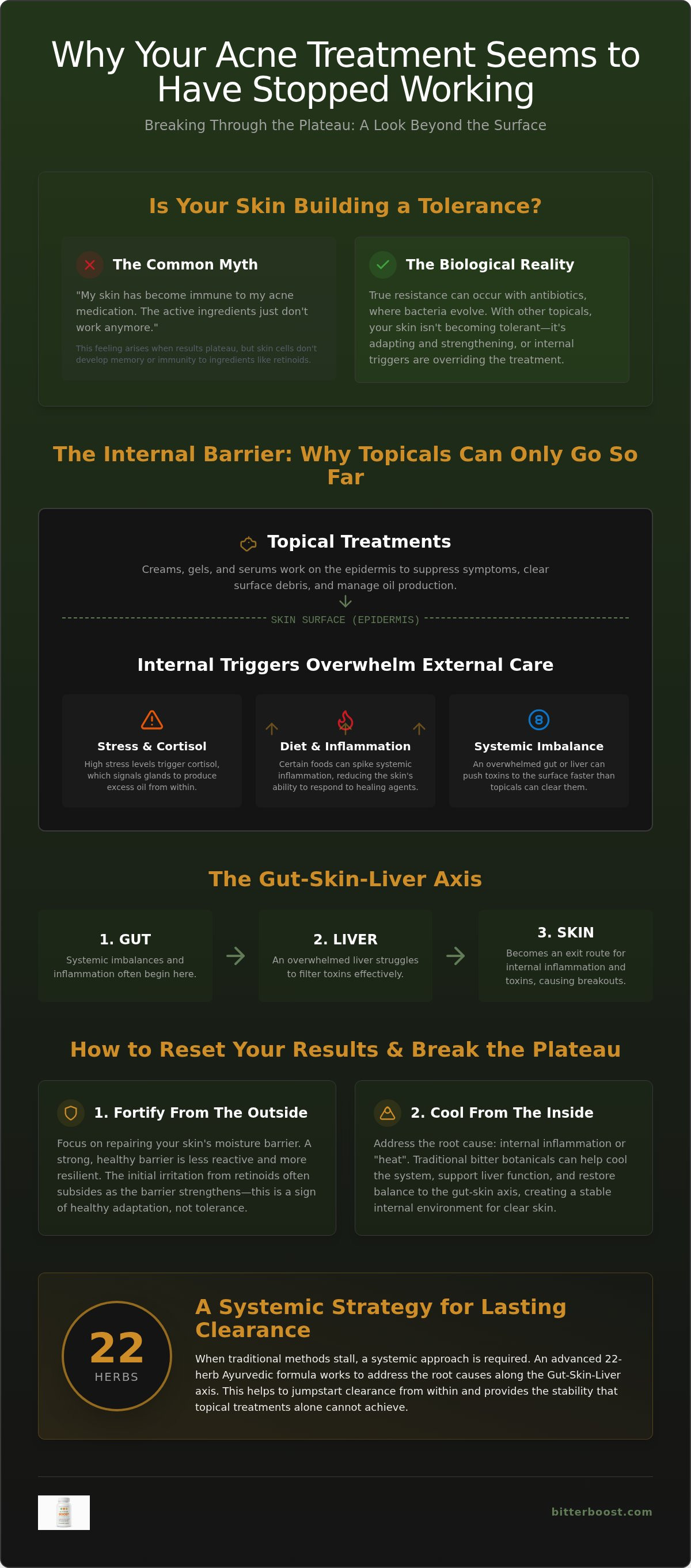
What if the problem isn't actually on your skin, but beneath it? Most modern skincare focuses entirely on the surface. We scrub, we peel, and we medicate. Yet, the skin is an organ of elimination. It's the mirror of your internal state. To find lasting clarity, you must look at the Gut-Skin-Liver axis. This interconnected system dictates how your body processes toxins and regulates inflammation. When this axis is out of balance, even the most advanced topical formulas will eventually hit a wall. You aren't just treating a surface blemish; you're managing a systemic signal.
Ayurveda offers a profound perspective on this struggle. It views persistent acne as an accumulation of "Pitta," or internal heat, within the blood and liver. This heat is often the result of a modern lifestyle, processed foods, and chronic stress. When your internal environment is "hot," it manifests as the red, angry, and treatment-resistant breakouts that feel so discouraging. Understanding a gut skin connection supplement can help you address this inner balance, ensuring your skin isn't constantly fighting an uphill battle against your own biology.
The Liver's Role in Skin Clarity
The liver is your body's primary filtration system. Its job is to neutralize toxins and metabolic waste. If the liver becomes overloaded, it cannot process these substances efficiently. The body then looks for an alternative exit. The skin is that exit. When toxins are pushed through the pores, they cause inflammation and congestion. This is often why patients feel like they are skin building tolerance to acne medication; the topical cream is trying to clear the exit, but the liver is still pumping out the waste. Supporting your liver's natural detoxification process can "unlock" your routine, allowing your topicals to finally do their job without being overwhelmed by internal debris.
Gut Microbiome and Skin Sensitivity
Your gut is the gatekeeper of your immune system. If the intestinal lining is compromised, often called "leaky gut," undigested particles and toxins can enter the bloodstream. This triggers a state of systemic inflammation. Your skin becomes reactive and hypersensitive. In this state, your skin's response to medication shifts from healing to merely surviving. To stabilize this, you must soothe the digestive tract. Traditional bitter herbs have been used for centuries to support these internal pathways by stimulating digestive enzymes and cooling the blood. When the gut is calm, the skin follows.
How to Support Your Skin When Traditional Meds Stall
When your results begin to fade, your first instinct might be to add more active ingredients. Don't. Doubling down on harsh acids often leads to a compromised moisture barrier rather than clearer skin. If you suspect your skin building tolerance to acne medication is the reason for your plateau, the solution isn't more friction; it's more support. It's time to shift your focus from the surface to the system. By following a structured reset, you can break through the stall and restore your skin's natural resilience.
- Step 1: Simplify your topical routine. Strip back to the basics. Focus on hydration and barrier repair for at least two weeks to let your skin breathe.
- Step 2: Address 'Internal Heat.' Use cooling, bitter botanicals to soothe systemic inflammation from the inside out.
- Step 3: Track your triggers. Use a journal to link flares to your menstrual cycle or specific dietary choices like high-glycemic foods or dairy.
- Step 4: Introduce systemic support. Help your liver and gut process the metabolic waste that often causes treatment-resistant breakouts.
The Power of Bitter Herbs in Skin Recovery
Bitterness is the missing taste in the modern palate. We crave sweet and salty, but the bitter taste is what signals the body to detoxify and cool down. In Ayurveda, Neem and Turmeric are the gold standards for clearing the blood. They act as natural purifiers. Neem is legendary for its ability to soothe the skin, while Turmeric addresses the deep-seated inflammation that topicals can't reach. Guduchi, also known as Tinospora cordifolia, provides essential support for your immune response to acne-causing bacteria. It's a holistic synergy. These herbs work together to create an internal environment where breakouts simply cannot thrive. For those struggling with deeper, painful lesions, exploring a herbal supplement for cystic acne can provide the targeted relief your routine is missing.
Creating a 'Clear Skin' Environment
Clear skin requires more than just the right ingredients; it requires a stable environment. Stress is a primary driver of skin flares. When cortisol levels spike, your oil production follows. Incorporating adaptogenic support can help your body manage these surges without manifesting them on your face. Hydration and fiber are equally critical. They act as the "broom" for your system, flushing out the metabolic waste that your liver has filtered. Without adequate fiber, those toxins can be reabsorbed, leading to the very plateaus you're trying to avoid. If you're ready to move beyond the cycle of skin building tolerance to acne medication, it's time to try a systemic approach to skin health that addresses the root cause of the plateau.
Breaking the Plateau with Bitter Boost
When your skin hits a biological ceiling, it's a signal. It's time to stop looking at the surface and start looking at the source. This is where Bitter Boost steps in. It's not a temporary patch. It's a systemic reset. While you may feel like your skin building tolerance to acne medication is an ending, it's actually an invitation to evolve your routine. True clarity isn't something you apply. It's something you cultivate from within. By supporting the internal organs that filter your blood, you provide the stability your skin has been craving.
Radiant Skin Begins on the Inside
Bitter Boost is a founder-formulated Ayurvedic supplement designed to address the root causes of treatment-resistant skin. It contains a proprietary 22-herb blend, including Neem, Turmeric, and Guduchi. This formula acts on the gut, liver, and immune system simultaneously. It's a comprehensive approach to internal harmony. While topicals only address the exit point, Bitter Boost addresses the filtration process. It cools the blood and calms the systemic heat that drives inflammation.
Real-world results speak to this potency. Some users, like Dorota, have reported a visible turnaround in their complexion within just 3 days of starting the high-dose phase. This rapid response is possible because our blend utilizes both whole-herb powders and concentrated extracts. This provides "full-spectrum" support. You get the traditional wisdom of the whole plant alongside the modern potency of standardized extracts. It's a bridge between ancient tradition and contemporary needs. Your skin doesn't need more harsh chemicals. It needs the quiet strength of botanical balance.
Your 30-Day Protocol for Internal Clarity
To break through a stubborn plateau, we recommend a specific protocol. Start with the "High-Dose" Phase. Take 2 capsules three times daily. This concentrated dose jumpstarts the liver and gut, clearing out the metabolic waste that has been surfacing as acne. After you achieve your desired level of clarity, you can transition to a maintenance phase of 1-2 capsules daily. In the first week, many users notice a shift in their overall vitality and a reduction in the "angry" redness of active flares. The skin begins to feel less reactive and more resilient.
We believe in the integrity of our process. Every bottle of Bitter Boost is cGMP-certified and manufactured with COA-tested ingredients to ensure purity and potency. We understand the frustration of feeling like you've tried everything on the market. That's why we offer a 30-day money-back guarantee. It's a risk-free way to test the internal approach and see if it's the missing link in your journey. You don't have to settle for a plateau. Experience the power of Ayurvedic bitters with Bitter Boost and rediscover the confidence of naturally clear skin.
Reclaiming Your Skin’s Natural Equilibrium
A plateau isn't an ending; it's a signal that your body requires a deeper level of care. While you might worry about your skin building tolerance to acne medication, the reality is often that your internal triggers have simply overtaken your topical routine. By shifting your focus toward the gut-skin-liver axis, you address the root cause of inflammation rather than just the surface symptoms. Stability comes from within.
Ayurvedic expert Simeon Chokoisky formulated Bitter Boost to provide this exact systemic support. This proprietary 22-herb blend features potent botanicals like Neem, Turmeric, and Amla to cool the blood and support natural detoxification. Every bottle is manufactured in a cGMP-certified facility in the USA, ensuring the highest standards of purity. You don't have to stay stuck in a cycle of temporary fixes.
Start your journey to clear skin with Bitter Boost - 30-Day Money-Back Guarantee
Trust the wisdom of your body. You're ready to move beyond the plateau and embrace the quiet confidence of lasting, systemic health.
Frequently Asked Questions
Can my skin become immune to salicylic acid or benzoyl peroxide?
No, your skin doesn't develop immunity to these chemical exfoliants or antimicrobial agents. Instead, your skin reaches a point where the surface treatment can't keep up with internal inflammation. If you feel like your skin building tolerance to acne medication is happening with these OTC actives, it's usually a sign that the root cause is systemic. Your skin has simply adapted to the product's intensity and requires deeper, internal support.
What should I do if my prescription acne cream stops working?
Consult your dermatologist to rule out bacterial resistance first. If the medication is still appropriate, consider simplifying your routine to repair the moisture barrier. Often, a plateau occurs because the skin is too irritated to heal. This is the ideal time to investigate internal triggers like gut health or liver function. Supporting these pathways can help your prescription become effective once again by reducing the overall inflammatory load on your system.
Is it possible to build a tolerance to Accutane or retinoids?
True biological tolerance doesn't happen with retinoids or isotretinoin. Your skin cells continue to respond to the vitamin A signals throughout treatment. However, you might stop seeing the initial "glow" or rapid improvement once your skin's cell turnover rate has stabilized. If breakouts persist, it suggests that hormonal or inflammatory signals from within are overriding the medication's ability to regulate your pores. You've reached a biological ceiling that requires a shift in strategy.
How do I know if I have antibiotic resistance from acne meds?
Resistance is likely if your skin showed significant improvement on antibiotics but then experienced a sudden, aggressive flare while still on the medication. This happens when bacteria evolve to survive the treatment. It's distinct from your skin building tolerance to acne medication. If your topical or oral antibiotics no longer control your breakouts, it's time to pivot toward non-antibiotic, systemic support that targets the root cause from within.
Can bitter herbs really help with hormonal or cystic breakouts?
Yes, bitter herbs like Neem and Turmeric target the internal heat and inflammation that drive deep, cystic acne. In traditional wisdom, these botanicals help the liver filter out the excess hormones and toxins that cause monthly flares. By cooling the blood and supporting the gut, bitter herbs address the "why" behind the breakout. This provides a level of stability that surface-level creams simply cannot reach, especially for those with stubborn, hormonal patterns.
How long does it take for internal skin supplements to show results?
Many users notice a shift in skin calm and redness within the first 3 to 7 days of a high-dose phase. However, lasting structural change follows the skin's 28-day renewal cycle. You should commit to a consistent internal protocol for at least one full month. This allows your body to reset its detoxification pathways and establish a new, clearer baseline for your complexion. Patience is the foundation of long-term skin health and internal harmony.
Should I stop my current medication while taking Bitter Boost?
You don't need to stop your current routine unless advised by a medical professional. Bitter Boost is designed to work alongside your existing products as the "missing link" for systemic health. It provides the internal support that helps your topicals work more efficiently. Always consult with your doctor before making changes to prescription medications to ensure a safe transition. Combining external care with internal balance often yields the most sustainable results for your skin.
Why does my acne keep coming back even with a strict skincare routine?
Recurring breakouts are usually a sign that you're treating the symptom rather than the source. A strict routine only manages the surface. If your liver is overloaded or your gut microbiome is imbalanced, your body will continue to push waste through your pores. True clarity requires a dual approach. You must maintain your external barrier while simultaneously cooling the internal inflammation that triggers new spots. Harmony between the inside and outside is essential.